50% is the luck of the genetic lottery. The other 50% is our everyday decisions. It sounds like good news – and it is. In the fourth episode of the podcast "A Plan for a Long Life", the hosts talk to a geneticist from the Polish Academy of Sciences about what we really know about the role of genes in longevity, how lifestyle affects the expression of DNA, and why even with a tougher hand of cards you can play a better game.
About the "A Plan for a Long Life" podcast
"A Plan for a Long Life" is a podcast by Proxin Development – a Poznań-based developer with over 19 years of experience, the first in Poland to build the philosophy of longevity into the DNA of its development. Proxin is a company for which a property is not just floor area and location – it is an environment in which people are meant to live better, longer and on their own terms.
The podcast is hosted by Mirosław Borowicz – a lawyer, entrepreneur and investor with many years of experience in real estate projects, the creator of the Izera Park concept – and Dr Włodzimierz Kubiak – a physician, graduate of the Poznań University of Medical Sciences and an enthusiast of lifestyle medicine and longevity.
Episode 4: The genetics of longevity – what does science say?
The guest of the fourth episode is Professor Grzegorz Przybylski – a graduate of the Faculty of Medicine at the Medical Academy in Poznań, a researcher at the Institute of Human Genetics of the Polish Academy of Sciences, and a medical geneticist specialising in the genetics of cancer – particularly leukaemias and lymphomas – and in the genetics of ageing and longevity. He conducts research on genetically modified mice that live longer than control animals. Professor Przybylski is the author of 65 scientific publications cited over 2,300 times in the world's leading journals. He has completed research placements at the University of Pennsylvania and collaborates academically with centres in China.
How much really depends on genes? Science corrects the simplifications
The conversation opens with a question that troubles everyone interested in longevity: what percentage of our longevity is determined by genes, and what by lifestyle? Dr Kubiak cites data from the certification materials of the Polish Society of Lifestyle Medicine – a 15 to 30% influence of genes. Professor Przybylski confronts this with the latest paper published in Science, which produced surprising results.
"The fundamental problem is that our health and lifespan are affected by a great many different factors. Many of them are not connected with genes or our lifestyle at all. And they all modify the final outcome – that is, how long we will live." – Professor Grzegorz Przybylski, MD, PhD
Earlier studies on identical twins suggested the predominance of lifestyle – because if twins with identical DNA live for different lengths of time, then genes cannot be decisive. However, a new analysis isolated the external factors: accidents, infections, random events. Once these were separated out, the correlation in the twins' lifespans turned out to be very high.
"All the external cases were carefully separated out, and then it turned out there's a very good correlation in the lifespan of twins. They put the role of genes at around 50, even 55%. And in my view that is the most objective assessment of the situation." – Professor Grzegorz Przybylski, MD, PhD
The conclusions? Genes have a greater influence than previously thought – but the remaining 50% still lies in our hands.
What the genome is and how it works – explained without shortcuts
Professor Przybylski explains complex biology in a way that stays in the memory. The human genome is 3 billion nucleotides – a record of information which, printed out, would form a stack of books 300 metres high. Reading it without a break, 24 hours a day, would take 500 years.
"Imagine we're building a house. The architect plans everything – the foundations, the floors, the materials, the roof. That is the genome. But each crew that comes onto the site receives only the part of the information that concerns them. Someone digging the foundations doesn't need to know how the plumbing will be routed. That's roughly how a cell works." – Professor Grzegorz Przybylski, MD, PhD
In every cell only selected genes are active – different ones in muscle cells, different ones in nerve cells. When this precise mechanism is disrupted – for example, when genes that tell cells to divide without control switch on – cancer develops.
Epigenetics: how your lifestyle changes the way your genes work
One of the most important threads of the conversation is epigenetics – the mechanism by which we can genuinely influence which genes are switched on and which are silenced, without changing the DNA sequence itself.
"Besides the genome – that sequence of nucleotides we inherited and cannot change – the regulation of gene expression is very important. And this regulation happens at many different levels. Methylation – switching off – or demethylation – switching on – of a particular gene can occur. And we can influence this through our lifestyle." – Professor Grzegorz Przybylski, MD, PhD
Mirosław Borowicz sums up the idea precisely:
"We won't change our genome. But through lifestyle we can influence the greater activation or deactivation of certain processes connected with genes. Have I understood that correctly?" – Mirosław Borowicz
Professor Przybylski confirms: that is exactly how epigenetics works.
Less food – a longer life. What the mouse studies show
Professor Przybylski describes his own laboratory experiments, which shed new light on the role of diet in longevity.
"If we apply caloric restriction – giving less food – the mice start to live longer and get sick less. This extension of life in mice is in the order of 30%. Both groups receive the same food, only one group is given several dozen per cent less of it." – Professor Grzegorz Przybylski, MD, PhD
Dr Kubiak connects these observations with the earlier conversation about the Blue Zones:
"If we think about people who live a long time – in those longevity zones, within families – as a rule they are not obese. Someone who is 95 is usually a slim person." – Dr Włodzimierz Kubiak
The biological clock: can it be slowed down?
The speakers raise the fascinating question of the biological limit of human life – is there a boundary that cannot be crossed?
"120 years seems to be the maximum lifespan, but only for people with very good genomes. For most people this clock is set at somewhere in the 90s – and that's assuming the person doesn't fall ill with anything that causes their death sooner." – Professor Grzegorz Przybylski, MD, PhD
Interestingly, people who pass 100 stand out for something surprising – they have barely been ill their whole lives, and the risk of developing cancer after the age of 90 paradoxically falls.
"At a certain point these people begin to fade – as if the flame of a candle were burning out. And it seems that this is the end of our planned life, and we are unable to change it. But if we manage to extend our lives to 90 or 100 – and in good condition at that – then that is still a great achievement." – Professor Grzegorz Przybylski, MD, PhD
The genetics of obesity and cholesterol – when diet isn't enough
Professor Przybylski explains why some people can eat anything and stay slim while others gain weight despite their efforts – and when this is a matter of genes and when purely of habits.
"There are different levels of basal metabolism. There are people who have a very high one – they burn everything they eat. Others have a lower one, and either they'll watch their diet and do sport, or they'll be obese. There is both a genetic factor and a lifestyle factor here." – Professor Grzegorz Przybylski, MD, PhD
Genetically determined hypercholesterolaemia works in a similar way – people with this condition have very high cholesterol regardless of diet and require pharmacological treatment. This, however, is a small percentage of the population. In the vast majority, cholesterol levels can be effectively lowered by changing diet and reducing weight.
The environment you live in shortens life – regardless of genes and lifestyle
The professor draws attention to a factor that often escapes the debate about longevity – the quality of the air and the external environment.
"In Poland we have a huge problem with particulate matter. We have one of the highest levels in Europe. These particles penetrate the lungs; they are so small that we can't cough them out – they pass into the blood and wreak havoc in the body. It is estimated that tens of thousands of people in Poland die each year because of air pollution." – Professor Grzegorz Przybylski, MD, PhD
This is a factor for which neither genes nor lifestyle provide an answer – which is why the choice of where to live and of one's everyday environment has scientific significance, not merely aesthetic.
Three principles from the fourth episode
-
Genes account for around 50% of longevity – but the other 50% is your decisions. We are dealt particular cards. The question is not what we received, but how we play it. Those whom fate has dealt a tougher hand simply have to play more carefully.
-
Epigenetics works – lifestyle changes the expression of your genes. You can't change the DNA sequence, but through diet, movement, sleep and stress reduction we can influence which genes are active and which are silenced. This is not a metaphor – it is a mechanism confirmed in scientific research.
-
The environment you live in has scientific significance. Air quality, access to nature and the stress level of your surroundings are external factors that affect lifespan regardless of genome and habits. The choice of where to live is a health decision too.
Izera Park – a development built on the philosophy of longevity
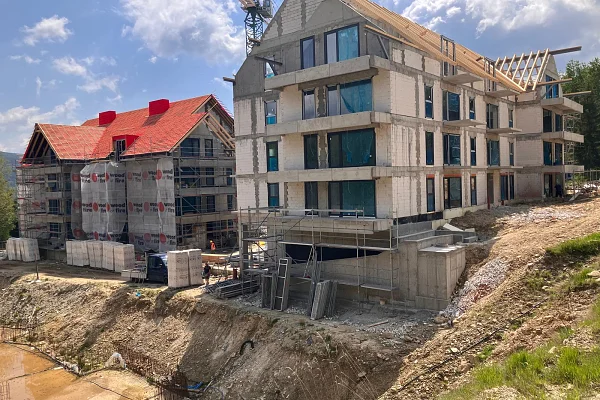
If you are hearing about Izera Park for the first time, it is a development with no equivalent in Poland. Izera Park is being built in Świeradów-Zdrój, in the heart of the Izera Mountains – a spa town with over 250 years of health tradition, famous for its radon waters and exceptional microclimate. It is a place that in itself benefits the body: clean air, quiet, forest and the rhythm of mountain life – exactly the environmental factors Professor Przybylski talks about in this episode.
The Izera Park development consists of 70 apartments in two intimate buildings, with varied floor areas suited both to personal use and to renting. Each apartment is full ownership – with no hotel restrictions and no obligation to rent. You use it when you want. You rent it if you want. You decide.
What sets Izera Park apart from the competition is not a single detail – it is a whole ecosystem designed with health and longevity in mind:
- A façade of natural board charred using the Japanese Yakisugi (Shou Sugi Ban) method – a centuries-old technique that gives the buildings a unique character and lets the architecture blend into the forest surroundings.
- The Longevity Studio – a dedicated service unit on the development's grounds, housing a Longevity Centre studio. Izera Park residents have priority access to it. Yoga, training and health workshops – all in the philosophy of lifestyle medicine.
- Ganbanyoku saunas – Japanese infrared saunas with a stone plate, supporting regeneration and detoxification without extreme temperatures.
- A yoga room – a space for daily practice, available to residents as part of the infrastructure.
- A natural stream on the development's grounds – water, sound and the closeness of nature right outside the window. A genuine space for regeneration, not decoration.
All apartments are designed with a view of the Izera Mountains. The gondola lift is 400 metres from the development.
Izera Park is not another aparthotel geared towards guest turnover. It is an intimate place for people who understand that the environment of everyday life – clean air, nature, community, calm – is just as important as diet and movement. As Professor Przybylski says in this episode: where you live shortens or lengthens your life regardless of what you eat and how you exercise.
Get in touch with the Proxin team: sprzedaz@proxin.pl / +48 603 711 805 / izerapark.pl