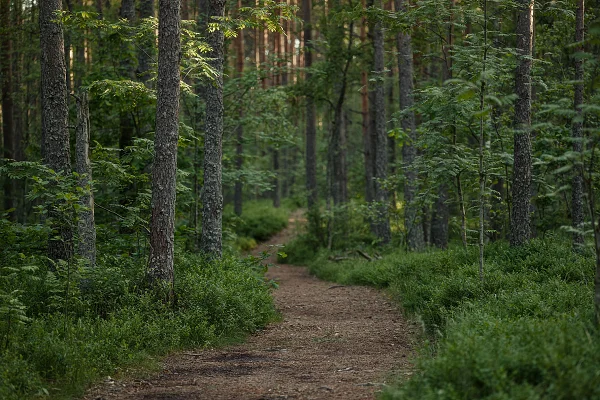
Forest bathing, or in Japanese shinrin-yoku, is the practice of mindful, multi-sensory time spent in the forest – with no goal, no haste, no phone. It is not a walk for fitness or jogging, but a conscious "immersion" in the atmosphere of the forest through sight, hearing, smell and touch. Forest bathing originates in 1980s Japan and today has a solid scientific foundation: studies link it with lower cortisol levels, calmer heart function and better wellbeing. Interestingly, the benefits come not only from the occasional trip to the forest – where we live day to day also matters.
This article is informational and educational in nature. Forest bathing supports wellbeing, but does not replace diagnosis or treatment – in case of health problems, consult a doctor.
What is forest bathing (shinrin-yoku)?
Shinrin-yoku is a compound of two Japanese words: 森林 (shinrin) – forest, and 浴 (yoku) – bath. Literally, then, it means "forest bath" and describes absorbing the atmosphere of the forest with all the senses. The term was coined in 1982 by Tomohide Akiyama of the Japanese Ministry of Agriculture, Forestry and Fisheries – as a response to rapid urbanisation, overwork and the growing detachment of the Japanese from nature.
Forest bathing differs from an ordinary walk. It is not about distance, pace or the number of steps, but about mindfulness: slowing down, breathing, switching off digital stimuli and opening the senses to the forest. This idea fits into the concept of biophilia – the thesis, popularised by the biologist E.O. Wilson, that humans have an innate need for contact with nature. The most famous populariser of forest bathing is Professor Qing Li of the Nippon Medical School, author of the book "Shinrin-Yoku: The Art and Science of Forest Bathing" (also published in Polish).
Forest bathing in a nutshell
| What it is |
mindful, multi-sensory time spent in the forest |
|---|---|
| Origin | Japan, 1982 |
| Meaning of the word | shinrin = forest, yoku = bath |
| Coiner of the term | Tomohide Akiyama (Ministry of Agriculture, Forestry and Fisheries) |
|
Foremost researcher |
Professor Qing Li, Nippon Medical School |
|
How it differs from a walk |
by mindfulness, not distance or pace |
| Effects according to research |
lower cortisol and blood pressure, calmer heart rate, activation of the parasympathetic nervous system, increased NK-cell activity |
| How much time | even about 2 hours produces measurable effects |
|
Where |
a forest, but also a large city park |
| What it does not replace | diagnosis and treatment |
How does forest bathing work? What the research says
Forest bathing acts on the body in several ways at once. The best-documented is the effect on the nervous and hormonal systems. In a widely cited study, Park and colleagues examined 24 forests across Japan with 280 participants: in the forest environment, compared with the urban one, participants had lower levels of cortisol (the stress hormone), lower heart rate and blood pressure, and higher activity of the parasympathetic nervous system, responsible for rest and regeneration.
The second mechanism is phytoncides – volatile organic compounds (including pinene and limonene) released by trees, especially conifers, to defend against microbes and insects. Studies by Professor Qing Li showed that inhaling the forest atmosphere raises the number and activity of NK (natural killer) cells of the immune system, and this effect persisted for some time after a visit to the forest. It is precisely to phytoncides that a large part of the forest's immunological action is attributed.
The benefits also concern the psyche. A study by Bratman and colleagues (2015) showed that a walk in nature – unlike a walk in the city – reduces rumination, that is, the persistent dwelling on negative thoughts, and lowers the activity of the brain area associated with it. A classic study by Ulrich (1984), in turn, showed that patients after surgery whose windows looked onto greenery recovered faster than those looking at a wall, and work by Faber Taylor and Kuo (2009) – that children with attention deficits concentrate better after a walk in the park.
It is worth being honest: some popular content attributes to forest bathing even the curing of diseases, including cancer. The evidence for such an effect is limited, and many results come from laboratory or short-term studies. Forest bathing is an effective support for prevention and wellbeing, not a therapy that replaces treatment.
Forest bathing and longevity
Does forest bathing extend life? There is no direct evidence that shinrin-yoku sessions alone prolong life – and this has to be said plainly. There are, however, indications linking contact with the forest and greenery to factors that favour longevity: lower chronic stress, better cardiovascular function, a more efficient immune system and better sleep.
Ecological studies have also appeared suggesting an inverse relationship between forest cover and cancer mortality in Japan, but their authors themselves stress the limited strength of the evidence – it is an observation at the population level, not proof of cause and effect. Much stronger arguments, however, are provided by another area of research: not how often we go to the forest, but the surroundings in which we live day to day.
Why where you live affects how you live
The most interesting thing is that the greatest health benefits come not from an occasional trip, but from daily closeness to greenery. A meta-analysis by Rojas-Rueda and colleagues, published in "The Lancet Planetary Health" and funded by the WHO, covered nine longitudinal studies from seven countries and more than 8 million people. The result: an increase of 0.1 in the greenery index of the area of residence (NDVI) was associated with about a 4% lower risk of death from all causes. In another review (Gascon et al.), residents of the greenest areas had about an 8% lower risk of death from all causes than residents of areas poorest in greenery.
These are observed relationships, not hard proof of causation – but the scale (millions of people, many countries) and the consistency of the results are impressive. The mechanism is, moreover, logical: greenery outside the window encourages movement, lowers stress, dampens noise, improves air quality and fosters neighbourly relations. In other words – forest bathing need not be an event we set out for. It can be the backdrop of everyday life. And it is precisely the place of residence that most determines whether we have access to it every day, or only on special occasions.
How to practise forest bathing?
Forest bathing is simple and free. You need no equipment or special fitness – just a forest (or a larger park) and a little mindfulness:
- Leave your phone in your pocket or in offline mode – the point is to cut off digital stimuli.
- Slow down. Do not set a route or a goal; walk more slowly than usual.
- Switch on your senses: listen to the rustle of the trees and the birds, smell the resin and the earth, touch the bark, watch the light between the branches.
- Breathe calmly and deeply – this strengthens the relaxation response.
- Stay longer. Research suggests that even about two hours brings measurable effects, but shorter, regular practice also brings benefits, e.g. in a park during a lunch break.
In Poland, forest bathing can be practised on your own or on organised walks with a guide or a certified forest therapist – there are more and more such offers and courses. A guide can be helpful at the start, but is not essential: the forest works regardless of whether someone leads us through it.
Forest bathing every day – not just on special occasions
Since it is daily closeness to the forest that gives the most, the natural question becomes not "where to go for forest bathing", but "where to live in order to have it within arm's reach". This is one of the ideas on which the longevity philosophy rests – designing a place to live so that health is supported not only by our habits, but by the surroundings themselves.
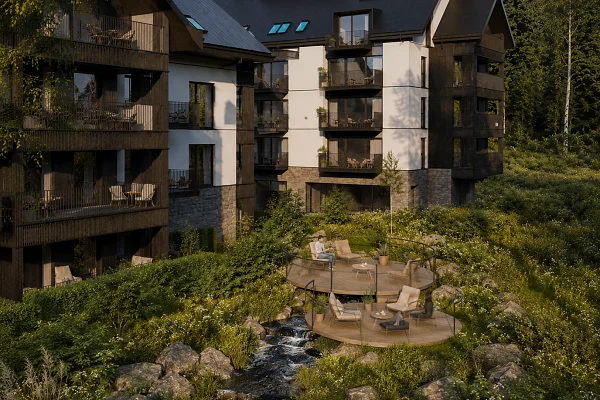
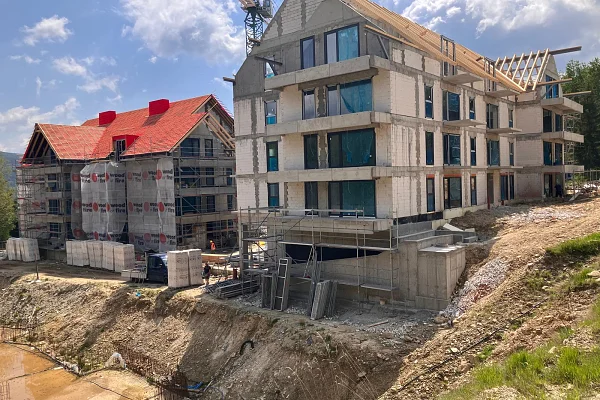
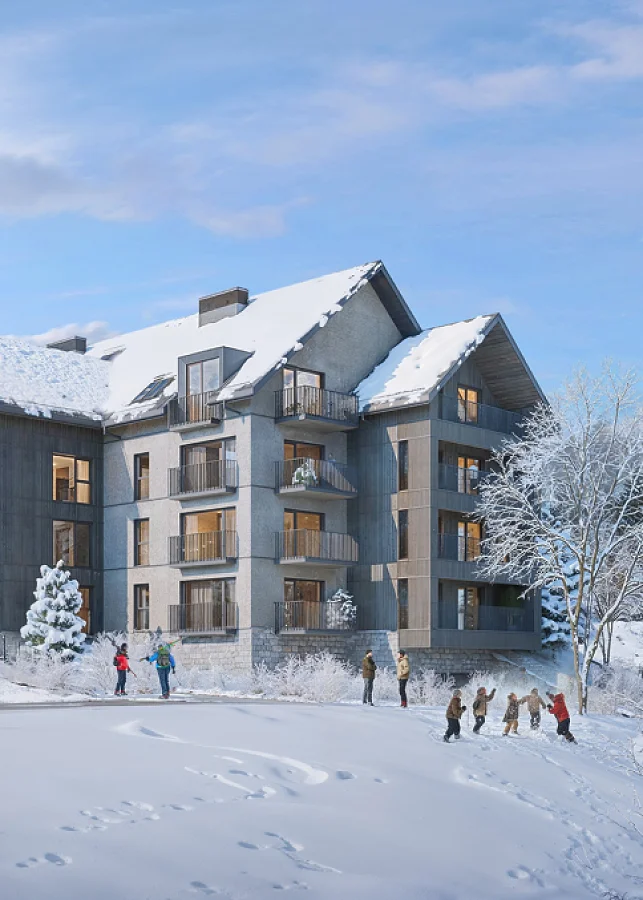
This is exactly how we designed Izera Park – an intimate development in Świeradów-Zdrój, in the Izera Mountains, surrounded by spruce forest and with a natural stream on the grounds. Forest, water and quiet are not an attraction here that you have to travel to, but the everyday backdrop of residents' lives.
It is complemented by regeneration infrastructure:
- a Ganbanyoku sauna,
- a yoga room, and
- the Izera Longevity Center.
Do you want forest bathing to be your everyday reality, not an exception?
Get in touch with us: +48 603 711 805, sprzedaz@proxin.pl, izerapark.pl
Frequently asked questions about forest bathing
What is forest bathing (shinrin-yoku)?
It is a Japanese practice of mindful, multi-sensory time spent in the forest. It consists of slowly absorbing the atmosphere of the forest through sight, hearing, smell and touch – with no set goal, distance or pace. This is what distinguishes it from an ordinary walk or jogging.
What does the word shinrin-yoku mean?
Shinrin-yoku is a compound of the Japanese words "shinrin" (forest) and "yoku" (bath), so literally "forest bath". The term was coined in 1982 in Japan.
How does forest bathing affect health?
Studies link it with lower cortisol levels, lower heart rate and blood pressure, activation of the parasympathetic nervous system and an increase in the activity of NK immune cells. It also helps to reduce stress and improve mood. It does not, however, replace treatment.
Does forest bathing affect longevity?
There is no proof that the sessions themselves prolong life. There are, however, strong epidemiological data showing that daily closeness to greenery at the place of residence is associated with a lower risk of premature death – in a meta-analysis involving more than 8 million people, more greenery in the area was associated with lower mortality.
How long should forest bathing last and how often should it be practised?
Research suggests that even about two hours brings measurable effects. Shorter but regular practice is also beneficial, for example a walk in the park several times a week.
Where can you practise forest bathing in Poland?
A forest or a larger city park is enough. You can practise on your own or on organised walks with a guide or forest therapist, whose offer in Poland is constantly growing.
Do you need a guide for forest bathing?
No. A guide or certified therapist can be helpful at the start, but is not essential – the forest works regardless of whether someone leads us through it.
Sources:
Park, B.J., Tsunetsugu, Y., Kasetani, T., Kagawa, T., Miyazaki, Y. (2010). The physiological effects of Shinrin-yoku (taking in the forest atmosphere or forest bathing): evidence from field experiments in 24 forests across Japan. Environmental Health and Preventive Medicine, 15(1), 18–26.
Li, Q. (2010). Effect of forest bathing trips on human immune function. Environmental Health and Preventive Medicine, 15(1), 9–17.
Rojas-Rueda, D., Nieuwenhuijsen, M.J., Gascon, M., Perez-Leon, D., Mudu, P. (2019). Green spaces and mortality: a systematic review and meta-analysis of cohort studies. The Lancet Planetary Health, 3(11), e469–e477.
Bratman, G.N., Hamilton, J.P., Hahn, K.S., Daily, G.C., Gross, J.J. (2015). Nature experience reduces rumination and subgenual prefrontal cortex activation. PNAS, 112(28), 8567–8572.
Ulrich, R.S. (1984). View through a window may influence recovery from surgery. Science, 224(4647), 420–421.
Faber Taylor, A., Kuo, F.E. (2009). Children with attention deficits concentrate better after walk in the park. Journal of Attention Disorders, 12(5), 402–409.
Get in touch with the Proxin team: sprzedaz@proxin.pl / +48 603 711 805 / izerapark.pl