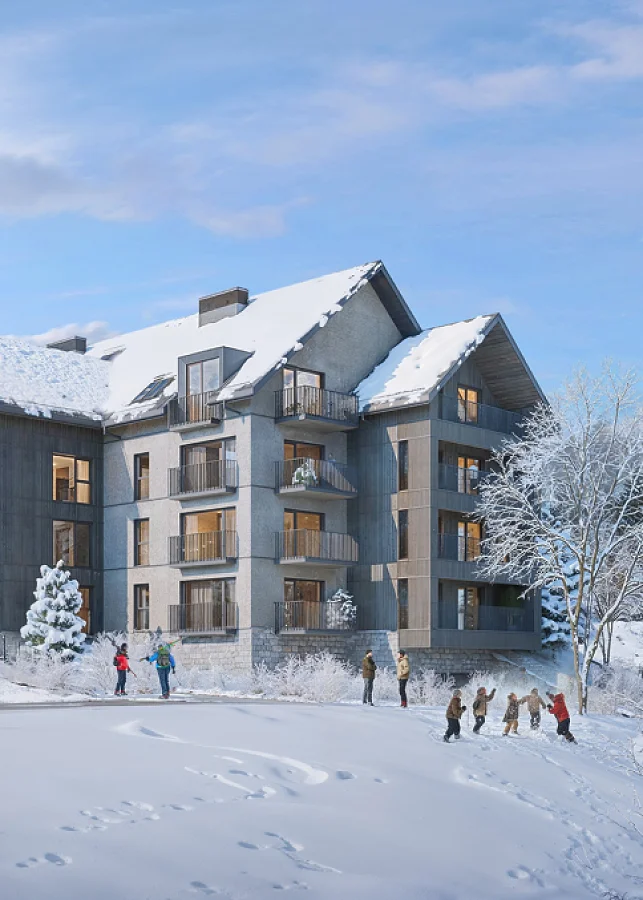
When we were designing the façade of Izera Park, we faced the choice made on most residential developments: render, clinker brick, composite panel – materials that are cheap to install, easy to maintain and unremarkable. We chose differently. The façade of both Izera Park buildings will feature wood charred using the Japanese method – Yakisugi, also known as Shou Sugi Ban. What is this technique, how does it work, and why is choosing it consistent with the entire philosophy of this project?
Yakisugi and Shou Sugi Ban – what is Japanese charred wood?
Yakisugi (焼杉) is a Japanese wood-treatment technique based on the controlled burning of a board's outer layer. The method emerged in Japan in the 17th–18th centuries, when it was discovered that charring the surface of wood naturally protects it against fire, moisture, pests and rot. In the Western world the technique is called Shou Sugi Ban – which loosely translates as "burnt cedar wood."
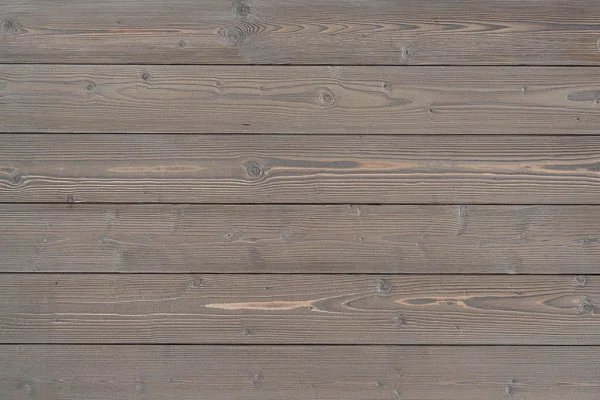
The process is simple to describe but demanding to perform: the board is exposed to intense fire until its outer layer becomes charred. The wood is then cooled and brushed to remove the loose char, revealing the characteristic dark, textured surface. During charring, the hemicellulose contained in the wood reacts with the flames, which permanently seals the pores and alters the material's chemical structure – making it hydrophobic, resistant to rot and unappealing to pests.
The traditional species was Japanese cedar (sugi); today the technique is also applied to larch, pine, oak and fir. Each species gives a slightly different effect – from deep, soft black to a texture resembling alligator skin.
How charred-wood protection works – the science behind the technique
The answer to the question "why is wood more resistant after burning than before?" lies in materials chemistry. The flames eliminate organic compounds and shrink the numerous pores present on the wood's surface. Shrunken pores do not absorb water, so the wood is very well protected against decay, moisture and rot. Charring also eliminates the sugars contained in the wood, which makes the material unappealing to insects. By burning off the cellulose, the wood's fire resistance increases – contrary to appearances, fire acts here as an excellent "impregnant." The charred surface layer is flame-retardant and forms a natural barrier against a potential fire, slowing its spread.
What about durability? Shou Sugi Ban wood lasts over 80 years without any special maintenance. In Japan, where the technique is most widely used, façade wood lasts from 80 to 150 years. It is estimated that wood protected in this way can serve for 50 to as much as 100 years – significantly longer than wood treated with traditional chemical methods.
For comparison: a standard acrylic-render façade requires renovation every 10–15 years, and composite panels lose their colour and texture after a dozen or so years. Yakisugi maintenance is minimal: oiling every 5–10 years is enough for the wood to retain its full aesthetics and properties.
A charred-wood façade versus a façade of synthetic materials – the real difference
The Polish development market is dominated by render and composite-panel façades. The reason is simple: lower material and installation costs. It is worth knowing, however, what price this carries in the long term.
Acrylic and silicone render – popular and cheap, but prone to dirt, algae and lichen in the humid mountain environment. In the Izera Mountains, where rainfall is higher than in the lowlands, rendered façades lose their good looks faster. They require painting and renovation every few years.
Composite panels and PVC cladding – they look like wood but are not. Over time they fade under UV radiation, lose their texture and stop harmonising with their surroundings. They are not thermally neutral – in the sun they heat up considerably more than natural wood. They are made of plastics that generate a carbon footprint in production and a disposal problem at end of life.
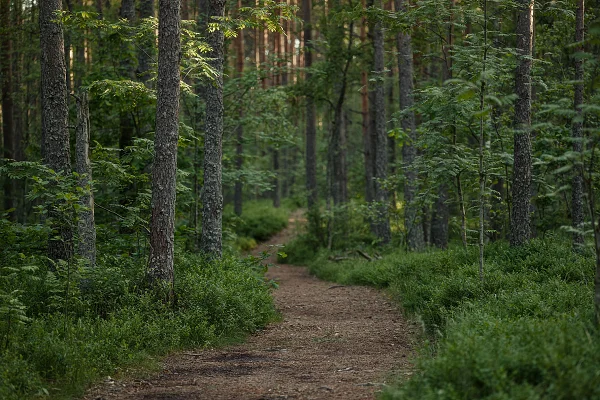
Yakisugi – a natural material, free of chemical impregnants, with a lifespan of several decades. Its dark colour comes from the charring process, not from dyes. Over time it may grey slightly under UV, which many architects regard as an aesthetic asset – the material ages with dignity, blending into the landscape. In a forest and mountain setting a dark façade is mimetic – it merges with its surroundings instead of contrasting with them.
Yakisugi in architecture – from Japan to the world's finest projects
For centuries the Shou Sugi Ban technique was the domain of Japanese villages and traditional building. In recent decades it has been discovered by the world's leading architects, who have begun using it in premium developments across the globe.
Yakisugi appears on the façades of exclusive villas in Scandinavia, residences in the USA, and luxury boutique hotels in Japan and Western Europe.
In Poland it is still a rarity – used mainly in high-end architectural projects where the priority is material quality and consistency with the surroundings. In recent years the dark, textured surface of charred boards has become one of the most recognisable hallmarks of contemporary premium architecture. Not because it is fashionable, but because it is honest: it states plainly what it is made of and does not pretend to be something it is not.
Why charred wood – not an imitation – matters for health and wellbeing
This is not merely a question of aesthetics. There is science behind it. Biophilic design – an architectural movement grounded in scientific research – holds that people function better in environments close to nature. Contact with natural wood encourages a state of relaxation and helps lower blood pressure and heart rate.
Research indicates that contact with nature supports an increased capacity for self-control – being among nature teaches patience and helps delay gratification, which is of key importance for mental health.
According to the principles of biophilic design, façades of wood, stone, brick and clinker are ideal, because their colours and textures relate directly to the colours of nature – browns, greys and ochre tones. Artificial panels imitating wood do not produce this effect – the brain recognises the imitation and does not activate the same relaxation mechanisms as contact with an authentic material.
For Izera Park, a development based on the philosophy of longevity and a long, healthy life, this is not a detail. It is one of the foundations.
Yakisugi at Izera Park – why this choice is no accident
Izera Park is a project we built around a single idea: that the environment you live in should actively support your health – not merely avoid harming it. Every element of the development stems from this philosophy.
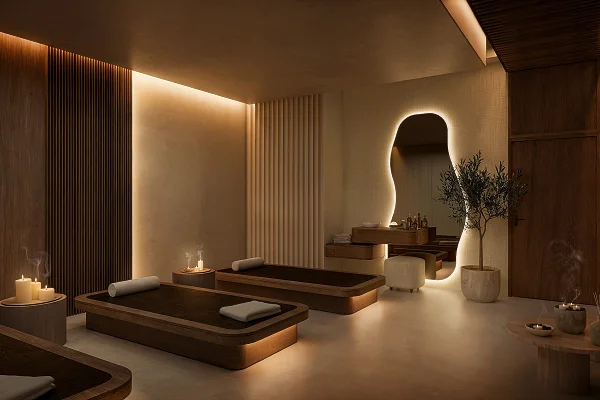
The location in Świeradów-Zdrój is no random mountain resort – it is a place with over 250 years of spa-treatment tradition and a radon microclimate unique on the scale of Central Europe. The natural stream on the development's grounds, the Ganbanyoku sauna and the yoga room in the shared areas, the Longevity Studio with access to diagnostics and specialists – each of these elements serves a specific purpose.
Yakisugi fits this logic on three levels.
Philosophical: The wood-charring technique comes from Japan – a country with the longest average life expectancy in the world and a culture that for centuries has combined simple materials with a deep respect for nature. Ganbanyoku in the sauna, Yakisugi on the façade, the longevity philosophy of the project – these are not a collection of random choices but a coherent system of values.
Material: Natural wood with no chemical impregnants. No emissions of the harmful compounds typical of synthetic façade materials. A material that, as the years pass, does not degrade the environment but ages naturally.
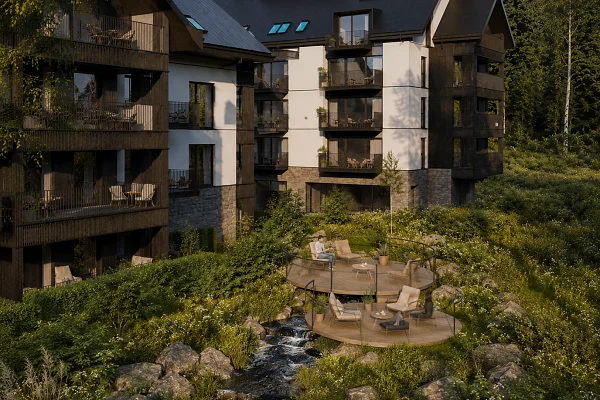
Aesthetic: A dark façade of charred boards harmonises with the forest and the stone of the Sudetes. Izera Park is not meant to stand out with the garish white of render – it is meant to grow into the landscape. A building that blends into its surroundings while remaining uncompromisingly high in quality.
Izera Park – a project setting a new standard
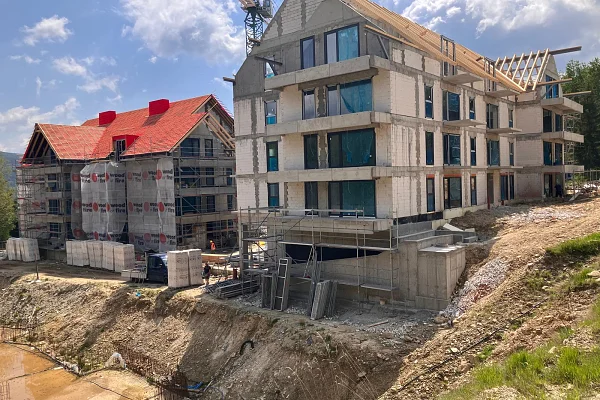
Izera Park is 70 apartments in 2 intimate buildings in Świeradów-Zdrój, in the Izera Mountains. Floor areas from 26 to 73 m², full ownership – without the restrictions of a condo hotel. Completion date: Q2 2027.
Project highlights:
- Yakisugi (Shou Sugi Ban) façade,
- Longevity Studio (priority for residents),
- Ganbanyoku sauna,
- yoga room,
- ski room and bike room,
- a natural stream on the grounds,
- gondola lift 500 m from the development.
Location at the meeting point of the Polish, Czech and German borders – Prague 150 km, Dresden 160 km, Berlin 280 km.
Frequently asked questions about Yakisugi and Shou Sugi Ban charred wood
What is Yakisugi?
Yakisugi (焼杉) is a Japanese wood-charring technique based on the controlled charring of a board's outer layer. The process naturally protects the wood against moisture, pests, fungi and fire – without using chemical impregnants.
How does Yakisugi differ from Shou Sugi Ban?
It is the same technique under two different names. Yakisugi is the original Japanese name; Shou Sugi Ban is the term used in Western countries, derived from the Chinese reading of the Japanese characters.
How many years does a charred-wood façade last?
With minimal maintenance (oiling every 5–10 years) a Yakisugi façade lasts 50–80 years. In Japan, where the technique has been used for centuries, historic façades survive for 80–150 years.
Does charred wood require maintenance?
It requires minimal maintenance compared with traditional wooden façades. Oiling every 5–10 years is recommended. It needs no painting, staining or chemical treatments.
Is a charred-wood façade resistant to mountain conditions?
Yes – the Yakisugi technique performs excellently in humid, variable weather conditions. The charred layer is hydrophobic and resistant to frost, UV radiation and fungi, which makes it particularly suitable for a mountain climate.
Is charred wood eco-friendly?
Yes. Yakisugi is one of the most environmentally friendly façade materials: it requires no chemical impregnants, is fully biodegradable and has a significantly lower carbon footprint than synthetic materials.
Get in touch with the Proxin team: sprzedaz@proxin.pl / +48 603 711 805 / izerapark.pl