The longevity philosophy in architecture means choosing spaces and a lifestyle that genuinely support health, mental balance and longevity. It is a move away from ostentatious luxury towards air quality, access to nature, functional architecture and everyday habits that foster residents' wellbeing.
This approach is part of the global, rapidly growing trend of wellness real estate – a building concept in which the home is no longer just a "machine for living" but an active tool supporting physical and mental health. In this model the building becomes your ally: it filters pollution, optimises access to light and encourages movement, turning a passive property into a health-promoting investment.
Increasingly, it is simplicity, calm and a conscious choice of location that are becoming the new mark of status. In what follows, we explain how to find a place to live in the longevity philosophy and how architecture and surroundings can support health and a sense of balance.
Leading a simple life: the longevity philosophy – a change in how we think about health and happiness
The longevity philosophy is a conscious investment in the future. Unlike a reactive approach to health, it focuses on prevention, extending the period of physical and mental fitness and consciously experiencing a state of wellbeing – moments of the happiness we long for. Genetics plays a large role in longevity, but it is lifestyle choices that have a greater impact on overall health and lifespan.
In the regions known as Blue Zones, average life expectancy exceeds 90 years. This is no accident. The inhabitants of these areas combine moderate physical activity, strong social bonds and a sense of purpose – something the Japanese in Okinawa call Ikigai. The Ikigai philosophy encourages engaging in activities that bring joy and fulfilment, which can extend longevity. It is there that the subject of happiness is dealt with not by theorists, but by practitioners of everyday life.
In the context of longevity it is not about mythical prescriptions, but about an existence full of fulfilment. That elusive happiness is given by repeated good habits rather than one-off successes. Wealth does indeed provide comfort, but it cannot replace the experience of peace of mind or relationships with people.
Does wealth really bring joy? Reality versus illusion
In the debate about the meaning of happiness, a question often arises: does a person desire happiness through possession? In a culture of excess it is easy to equate fulfilment with further financial achievements or social status. It turns out, however, that beyond a certain income level, rising earnings do not translate proportionally into greater wellbeing. At a certain point, material goods stop increasing satisfaction in a noticeable and lasting way.
It is increasingly clear that a pointless pursuit of happiness based on consumption leads nowhere. The belief that the next purchase will bring lasting fulfilment turns out to be an illusion – momentary excitement quickly gives way to habituation. This clash of reality with expectations shows that we encounter happiness more often in experiences than in objects. In practice, the pursuit of status is often something quite different from genuine care for wellbeing.
This does not mean money has no significance. It provides security, stability and the ability to choose. But only when it ceases to be an end in itself and becomes a tool for building quality of life. For many people, owning their own home is a symbol of stability. Yet the property itself does not guarantee fulfilment – what matters is how we live in it and whether the space fosters relationships, rest and slow living, that is, a conscious, less hurried way of functioning.
From the perspective of our own experience, happiness rarely stems from excess. More often it appears when we are able to find meaning in everyday life – in relationships, work, growth or being outdoors. For an adult, happiness usually means:
- emotional stability,
- having a true friend,
- health,
- the ability to decide how to spend one's time,
- contact with nature.
This changes how we perceive happiness and prompts us to rethink everyday choices – including the choice of where to live and how we organise our time and energy. Ultimately, we can achieve happiness not by multiplying possessions, but through conscious decisions that strengthen relationships, health and a sense of meaning.
How to live by the longevity philosophy?
Healthy lifestyle habits can extend life expectancy by as much as 10 years. Although average life expectancy worldwide has risen significantly thanks to advances in medicine and improved living conditions, today it is everyday decisions that are crucial to the quality and length of our lives. Chronic diseases remain the leading cause of death in old age, which is why prevention and lifestyle modification are the foundation of real longevity.
If you are wondering how to live by the longevity philosophy, it is worth referring to the five pillars of longevity.
The first pillar is access to a healthy, balanced diet, based on unprocessed products rich in fibre, antioxidants and healthy fats.
The second pillar is daily, moderate physical activity. Regular movement helps maintain muscle mass, which in the longevity philosophy is treated as a key metabolic resource.
The third element is closeness to greenery and nature, which lowers stress levels and supports the regeneration of the nervous system.
The fourth pillar – reducing stress and slowing the pace of life – translates directly into sleep quality. Sleep of 7–8 hours enables the brain to regenerate, hormones to stabilise and repair processes to be triggered at the cellular level.
The fifth pillar is strong social relationships. A sense of belonging, emotional support and satisfaction from human contact have a measurable impact on health.
A holistic approach to prevention is not limited to reacting to symptoms; it aims to slow cellular ageing and protect against lifestyle diseases. It encompasses early diagnostics, conscious stress management, and care for diet, movement and regeneration. In the longevity philosophy it is not about a single element, but about a coherent lifestyle. Improving quality of life begins with everyday decisions – and it is these that have the greatest power in building a long, healthy and satisfying life.
If you would like to discover our plan for a long life, take a look at the premiere episode of our podcast: https://www.youtube.com/embed/L5iWfZVt0dk
Simple living and a building's clean label as luxury
Why are quiet, time and space becoming a luxury today? More and more people want a comfortable life, but understood differently from a decade ago. Modern comfort is not based solely on prestige or floor area, but on the quality of everyday functioning. The idea of simple living does not mean giving things up or accepting restrictions imposed from outside. It means a conscious choice and reflection on what truly supports health and helps lead a happy life.
Leading a simple life means, above all, limiting the excess of stimuli that overload the nervous system. It means a digital detox – a controlled disconnection from the constant stream of information. It means greater mindfulness in your decisions and a biohacking of space – designing an interior so that it supports regeneration, concentration and sleep quality. It also means caring for the circadian rhythm through access to natural light during the day and reducing artificial lighting in the evening. In this approach, achieving happiness lies not in intensifying experiences, but in ordering them.
A house or apartment stops being merely an address. It becomes a tool supporting health and emotional stability. A building's clean label – that is, the absence of toxic materials, good air quality and natural finishes – has real significance for the body. Natural materials, access to daylight, proper ventilation and acoustic insulation are no longer aesthetic details. They are elements that affect wellbeing – and therefore, in essence, being happy.
Meanwhile, happiness is ever less often linked with excess. More and more often we find it in small everyday pleasures – a morning coffee in silence, a walk among greenery, a peaceful evening without notifications. A change in how we perceive reality means that luxury ceases to be a demonstration of status and becomes a space in which we can genuinely feel happy day to day.
Longevity and architecture – the importance of place
In the longevity philosophy, the environment is hugely important. Where and how we live directly affects the quality of a healthy life and our long-term wellbeing. Each person's happiness depends on the surroundings in which they function day to day. Living amid noise, smog and permanent haste makes it harder to achieve full satisfaction and to maintain the habits that support the body in the process of healthy ageing.
At the same time, it should be remembered that each person's different needs determine which living conditions will truly suit them. For some, quiet and privacy will be key; for others, the proximity of the city and social energy. Longevity does not impose a single model of life, but encourages everyone to define their own definition of happiness and adapt their space to their real needs.
This is why more and more people are redefining the notion of luxury. Today, luxury is:
- quiet,
- access to green areas,
- proximity to infrastructure,
- the possibility of regular activity.
These are elements that deliver plenty of benefits – both physical and mental. The proximity of parks and walking paths encourages daily movement, makes it easier to pursue your interests such as running, cycling or gardening, and lets you make better use of your free time. A well-designed space also fosters the building of social relationships, which is one of the foundations of longevity and genuinely increases the chances of a happy life.
It is not about escaping the world or about isolation, but about creating the conditions to consciously experience everyday life. A space that supports regeneration, activity and relationships helps you become a happy person – which in turn translates into health, mental resilience and long-term quality of life. In the longevity philosophy, architecture is not a backdrop but an active tool supporting wellbeing.
Izera Park – longevity as a source of a good life and the essence of happiness
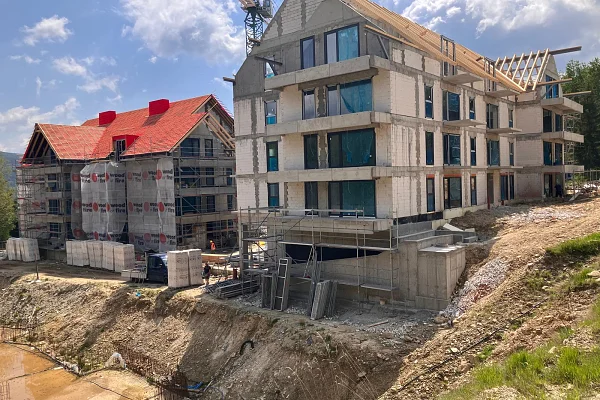
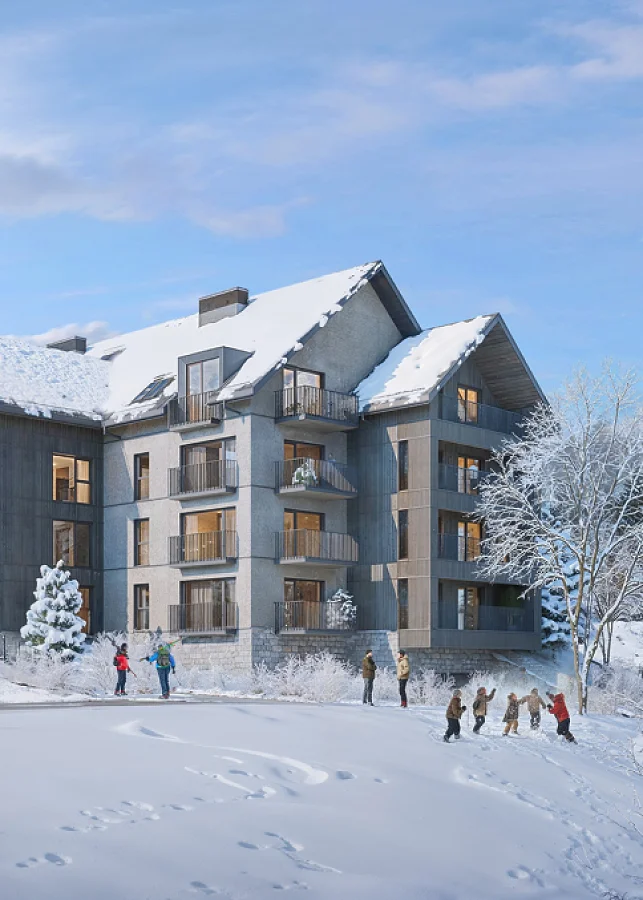
In the context of the search for happiness, it is worth looking at the Izera Park development. It is not another aparthotel geared solely towards tenant turnover. It is a development built with a second home in mind – a place you return to.
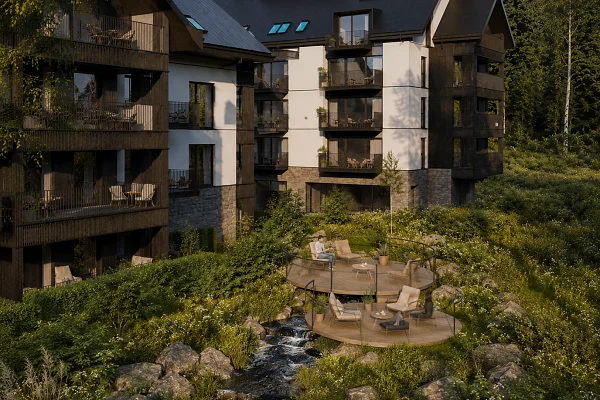
Izera Park is being built in Świeradów-Zdrój, a town with a 200-year spa tradition. The proximity of spruce forests, the natural lie of the land and the presence of a stream on the development's grounds support contact with nature – one of the pillars of longevity.
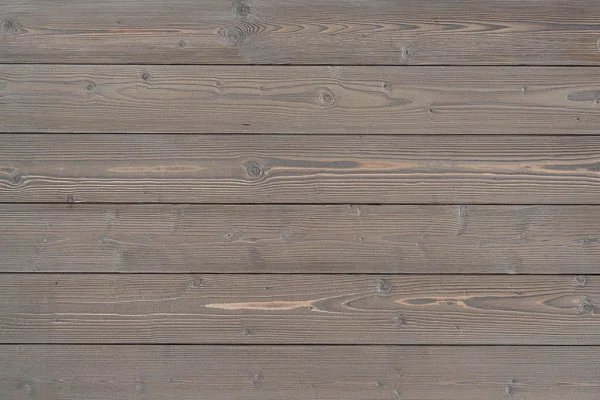
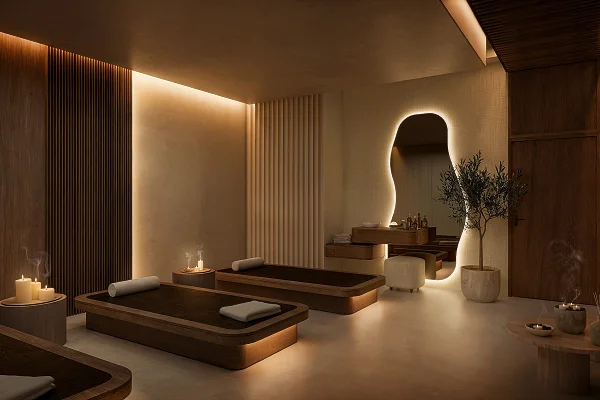
The project comprises two intimate buildings, a natural wooden façade charred using the Shou Sugi Ban method, panoramic windows and shared spaces such as Ganbanyoku saunas and a yoga room.
The development was also designed in the spirit of aging in place – without thresholds, with wide doors and a lift. This is a response to the challenges of an ageing society and a practical realisation of designs concerned with happiness over the long term.
Longevity here is not a marketing slogan. It is a design premise. Izera Park is a place where you can settle for good. Not just for now.
The expertise and responsibility of Proxin
The Proxin team has spent years designing developments with a long usage horizon in mind. In projects such as Izera Park, longevity is not an add-on – it is part of the identity of the place. Architecture, location and shared functions create a coherent environment supporting health and balance.
The longevity philosophy teaches us that the environment we inhabit programmes our health for years. That is why investing in apartments designed in this spirit is far more than a capital investment – it is a way of securing the quality of your future life. An investment in Izera Park apartments is a real answer to the need for a sanctuary that supports the body's repair processes and stress reduction. If you are looking for a place that combines the luxury of simplicity with a business model, take a look at our investment apartments in the mountains and see how the wellness real estate concept works for your longevity and stability.
If you would like to talk about how to consciously choose a place to live in line with the longevity philosophy, get in touch with the Proxin team. At the sales office you can calmly discuss the development's premises, your needs and your lifestyle expectations.
Get in touch with the Proxin team: sprzedaz@proxin.pl / +48 603 711 805 / izerapark.pl