What is the secret of a long life in good health? Diet, movement, genes? Or perhaps something you can't buy at the pharmacy – community, simplicity and closeness to nature? In the second episode of the podcast "A Plan for a Long Life", the hosts invite a guest who knows the subject of the Blue Zones from the inside – literally.
About the "A Plan for a Long Life" podcast
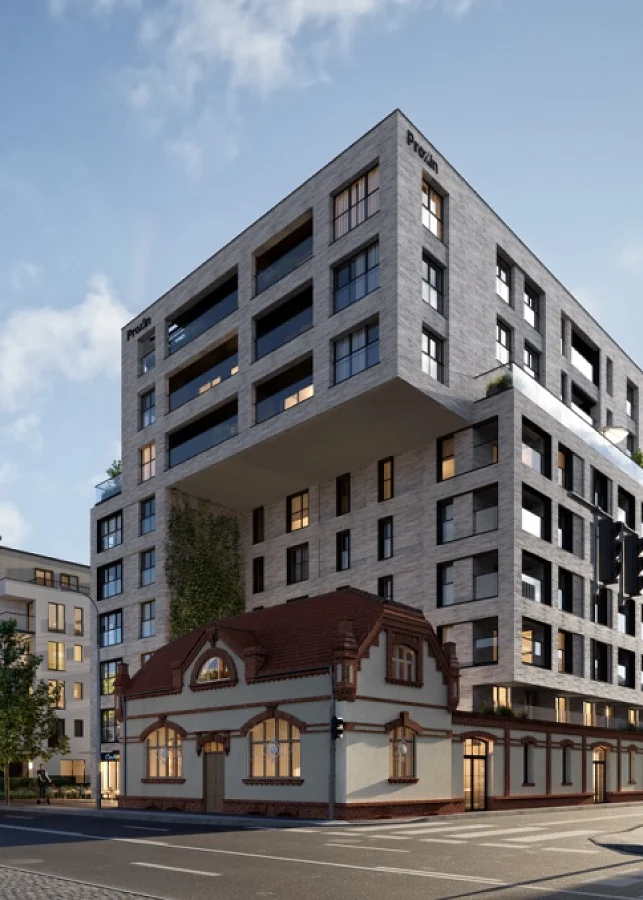
"A Plan for a Long Life" is a podcast by Proxin Development – a Poznań-based developer with over 19 years of experience, the first in Poland to build the philosophy of longevity into the DNA of its development. Proxin is a company for which a property is not just floor area and location – it is an environment in which people are meant to live better, longer and on their own terms.
The podcast is hosted by Mirosław Borowicz – a lawyer, entrepreneur and investor with many years of experience in real estate projects, the creator of the Izera Park concept – and Dr Włodzimierz Kubiak – a physician, graduate of the Poznań University of Medical Sciences and an enthusiast of lifestyle medicine and longevity.
Episode 2: The Blue Zones – places where longevity is the norm
The guest of the second episode is Agnieszka Pluto-Prądzyńska, PhD in Health Sciences – the originator and organiser of the "Lifestyle Medicine for Longevity – Blue Zones Inspirations" scientific conferences in Poznań, a lecturer at the Poznań University of Medical Sciences, a certified lifestyle-medicine trainer since 2019, a doctor of health sciences (doctorate: yoga, physical activity and quality of life, 2020), and an instructor of yoga and Slavic women's gymnastics.
What are the Blue Zones and where does the name come from?
The conversation opens with a question about the concept itself – where did the idea of the Blue Zones come from, and is it really science or a marketing myth?
Agnieszka Pluto-Prądzyńska explains that the story began in 2000, when the Sardinian doctor Gianni Pes came to a demographers' conference in Paris to report the exceptional longevity of his patients. It was decided to verify this scientifically, and Professor Michel Poulain was sent to Sardinia, where on a map he marked the zones of exceptional longevity with a blue pen.
"Professor Poulain is a joker, and whenever he gives a lecture he asks the question: 'I wonder what would have happened if I'd used a red pen – would the name have survived?'" – Agnieszka Pluto-Prądzyńska, PhD in Health Sciences
Today the Blue Zones are five demographically validated areas in the world:
- Sardinia (part of the island, the Ogliastra and Barbagia regions),
- Okinawa in Japan,
- Ikaria in Greece (the only zone covering an entire island),
- Nicoya in Costa Rica, and
- Loma Linda in California.
"These are not whole islands or whole countries. They are specific zones, defined by very strict demographic methods – verification of documents, government and church archives, cemeteries, field interviews. This is scientifically confirmed, not some fake." – Agnieszka Pluto-Prądzyńska, PhD in Health Sciences
What do these places really have in common?
The speakers get to the heart of the matter: what makes people there live so long and in such good condition? Dr Pluto-Prądzyńska points out that the answer is surprisingly simple – and at the same time hard to implement in the modern world.
Natural movement as part of life, not exercise
In the Blue Zones, no one went to the gym. Movement arose from everyday life – walking in the mountains, working the land, carrying water.
"On Ikaria I asked an elderly gentleman what his childhood was like. He replied: 'Well, either four kilometres uphill or four kilometres downhill.' If he wanted water from the stream, he could choose whether to go up with empty buckets or down with empty buckets." – Agnieszka Pluto-Prądzyńska, PhD in Health Sciences
Dr Kubiak adds: digging a garden with a spade is a better gym than many a fitness studio. For these communities, physical activity was a means of survival – not a discipline entered in a calendar.
Local, seasonal food, without excess
Sardinians in the mountain villages ate what they produced themselves or exchanged with neighbours. Bread was a rarity, meat appeared once a week in small quantities. No exotic products, no processed food.
"No one there ever ate fresh bread. Bread was baked for a week or ten days, and that's how it was eaten. What seems obvious to us – a daily roll, a fresh pastry – was a holiday luxury there." – Agnieszka Pluto-Prądzyńska, PhD in Health Sciences
In Okinawa the principle of Hara Hachi Bu is cultivated – eating only to 80% fullness, getting up from the table slightly hungry. Dr Pluto-Prądzyńska stresses that in each of these communities there was never malnutrition – they ate modestly, but in a balanced way.
Community and relationships as a pillar of health
This is a thread that appears in every longevity zone – strong social bonds, mutual care, respect for the elderly.
"I spoke with a Sardinian living in Poznań and asked him directly: what, in your view, causes this longevity? He said: 'The fact that we look after one another.' I asked: 'Within the family?' He replied: 'Not only within the family – for the neighbours too.'" – Agnieszka Pluto-Prądzyńska, PhD in Health Sciences
In Japan, people who reach the age of one hundred are celebrated – there are special community festivals. Dr Pluto-Prądzyńska draws attention to a phenomenon she calls "inheritance through observation": if it is normal for someone that their grandmother is 90 and does everything herself, that norm shapes their own expectations of old age.
"If people are told that 55 is already time for a senior programme, what does that do to the mentality of an entire society? There, people live to a hundred and are independent." – Agnieszka Pluto-Prądzyńska, PhD in Health Sciences
Isolation, nature and the absence of haste
Many Blue Zones are places cut off from the main routes – high mountains, remote islands, no roads. This isolation forced self-sufficiency, but it also protected against the stress of the modern world.
"What we have around us, where we live, should be the basis of our food, our movement and our way of life." – Agnieszka Pluto-Prądzyńska, PhD in Health Sciences
Genes or environment? Another voice in the debate
Dr Pluto-Prądzyńska addresses the topic of genetics and challenges even the cautious 15–25% from the previous episode, citing studies that point to genes having as little as a 3% influence on longevity.
"Inheritance through observation – it's not a scientific term, it's my joke. But the observation of the Blue Zones is clear: what matters is whom we spend time with and who serves as our model of behaviour. People from long-lived families who moved to a neighbouring village no longer reached such an age." – Agnieszka Pluto-Prądzyńska, PhD in Health Sciences
What can we carry over into our own lives today?
Towards the end of the episode, Dr Pluto-Prądzyńska gives listeners concrete, practical tips – homework for the next two weeks:
- Climb the stairs two steps at a time – imitating hilly terrain. A certain Japanese professor who, at 104, still travelled the world giving lectures attributed his longevity to this habit.
- Eat local and seasonal produce – from local farmers, with no processed food.
- Cut down on sugar – give up sweetened drinks and daily sweets. One pastry at the weekend, not a sweet roll every day.
- Eat less, but better – the Hara Hachi Bu principle: get up from the table slightly hungry.
- Build community – a smile to a neighbour, working in groups, caring for the elderly around you.
"We actually have a simple answer for how to live in order to live long in good health. Most of us feel and know it. The only problem is how to implement it – how to turn knowledge into habit." – Mirosław Borowicz
Izera Park – a development built on the philosophy of longevity
If you are hearing about Izera Park for the first time, it is a development with no equivalent in Poland.
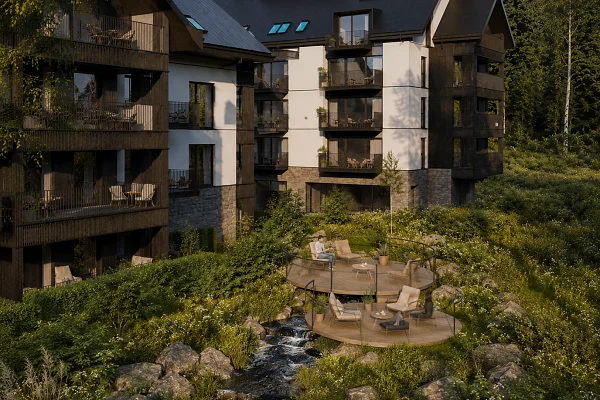
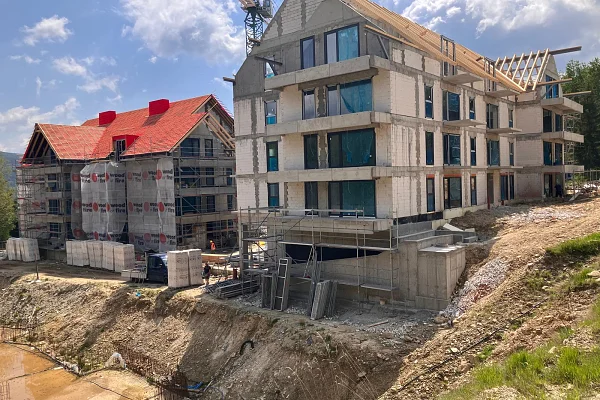
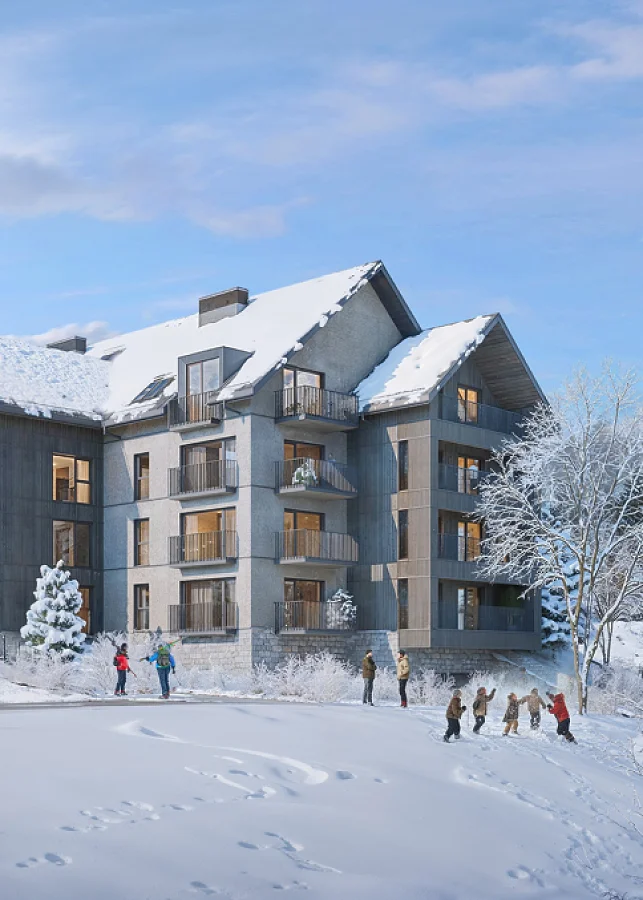
Izera Park is being built in Świeradów-Zdrój, in the heart of the Izera Mountains – a spa town with over 250 years of health tradition, famous for its radon waters and exceptional microclimate. It is a place that heals in itself: the air, the quiet, the forest and the rhythm of mountain life do their work – even before you open the door of your apartment.
The development consists of 70 apartments in two intimate buildings, with varied floor areas suited both to personal use and to renting. Each apartment is full ownership – with no hotel restrictions and no obligation to rent. You use it when you want. You rent it if you want. You decide.
What sets Izera Park apart from the competition is not a single detail – it is a whole ecosystem designed with health and longevity in mind:
- A façade of natural board charred using the Japanese Yakisugi (Shou Sugi Ban) method – a centuries-old technique that gives the buildings a unique dark character and lets the architecture blend into the forest surroundings rather than compete with them.
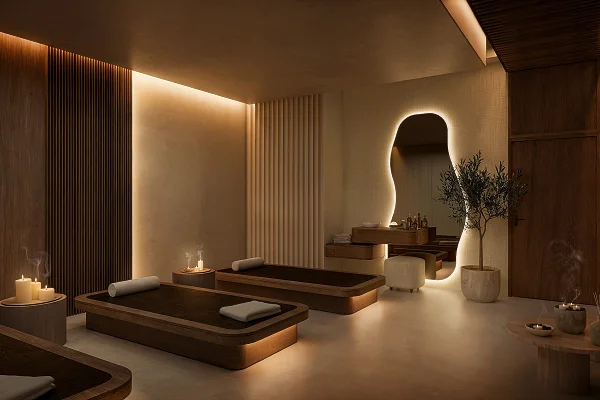
- Izera Longevity Center – a dedicated service unit on the development's grounds, housing a Longevity Centre studio. Izera Park residents have priority access to it. It is a place to work on yourself: yoga, training and health workshops – all in the philosophy of lifestyle medicine the podcast hosts talk about.
- Ganbanyoku saunas – Japanese infrared saunas with a stone plate, working in a completely different way from a traditional Finnish sauna. They deeply warm the body from within, supporting regeneration and detoxification – without extreme temperatures.
- A yoga room – a space for daily practice, available to residents as part of the infrastructure, not as a separately charged extra.
- A natural stream on the development's grounds – something you won't find in any aparthotel in the area. Water, sound and the closeness of nature right outside the window. Not as decoration – as a genuine space for regeneration.
All apartments are designed with a view of the Izera Mountains. The gondola lift is 500 metres from the development.
Izera Park is not another aparthotel geared towards guest turnover. It is an intimate place for people who want their own second home in the mountains and want that home to actively serve their health. Exactly like the people of the Blue Zones – close to nature, close to others, close to themselves.
Listen to the second episode of "A Plan for a Long Life" and take the first steps
Watch the episode: https://youtu.be/VjTWO7rJbu0