Accessibility in residential buildings means designing and constructing spaces so that they are comfortable and safe for all users – including older people and people with disabilities. It covers, among other things, the absence of architectural barriers, appropriate passage widths, lifts, ramps and clear signage, in line with the building regulations in force and the principles of universal design. In what follows, we explain which regulations set accessibility standards and how they are implemented in practice in modern residential developments.
Accessibility in residential buildings – an obligation or the standard of the future?
In the context of architecture and urban planning, the accessibility of residential buildings for people with special needs has become one of the key issues. It does not concern only people with disabilities – it also covers seniors, families with small children, neurodivergent people and those with temporarily limited mobility.
Under Article 5(1)(4) of the Building Act of 7 July 1994, multi-family residential buildings must be constructed in such a way as to provide people with disabilities with the necessary conditions for using them. In addition, in July 2019 the Act on ensuring accessibility for people with special needs was passed, which expanded developers' obligations and clarified building accessibility standards.
This means that the needs of people with disabilities must be taken into account as early as the investment process – not as an add-on, but as the foundation of design.
Building accessibility standards in the light of the regulations
The Regulation of the Minister of Infrastructure on the technical conditions that buildings and their location should meet sets out specific requirements.
For example:
- § 16(1) – the entrances to multi-family residential buildings should be reached by paved approaches at least 1.5 m wide, giving people with disabilities access to the entire building,
- § 70 – the maximum gradient of a ramp for wheelchair users is 6% outdoors and 8% indoors,
- § 55 – in a multi-family building not equipped with a lift, a ramp or another device must be provided to give access to apartments on the first storey,
- § 86 – at least one publicly accessible sanitary facility on the accessible storeys should be adapted for people with disabilities.
It is also important to provide adequate manoeuvring space at entrances, in shared rooms and at parking spaces. Their number should be matched to the overall number of parking spaces in the entire building.
Removing architectural barriers in practice
The regulations themselves are only a starting point. What is key are the design decisions made more with real users in mind.
Removing architectural barriers includes, among other things:
- the absence of thresholds and one step-free approach,
- wide doors and corridors providing manoeuvring space,
- lifts in all buildings,
- clear signage for blind people,
- a logical layout of shared rooms, including waste-storage areas,
- appropriately designed parking spaces.
Designing in line with the principles of universal design means creating a space accessible to all social groups – regardless of age, ability or lifestyle.
An inclusive place to live – more than technical accessibility
Inclusivity in residential projects is not only about meeting the requirements of the building regulations. It is about creating an environment that does not exclude.
A variety of apartment types, different unit areas and the option to shape interior layouts flexibly – all this helps build lasting communities. Within the overall number of residential units, it is worth accommodating different needs: one apartment for a single person, a larger one for families, layouts that suit seniors or people with disabilities.
Social inclusion is the process of including different social groups in the life of a community. Homeowners' associations, as well as housing cooperatives, can support inclusivity through joint decisions on the development of shared spaces or playgrounds.
Building accessibility for people with disabilities and location
No less important than the building itself is the plot and its surroundings. When developing it, one should bear in mind:
- proximity to urban infrastructure,
- access to public transport,
- safe approaches,
- green areas conducive to integration and activity.
The accessibility of facilities depends largely on their location. A place of residence should make it possible to take part in social life regardless of ability or age.
Izera Park – accessibility, inclusivity and longevity in practice
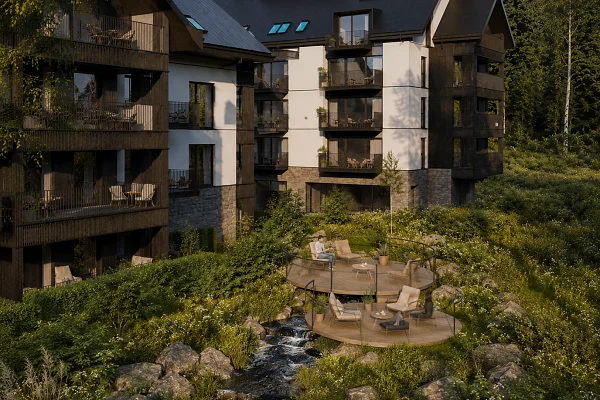
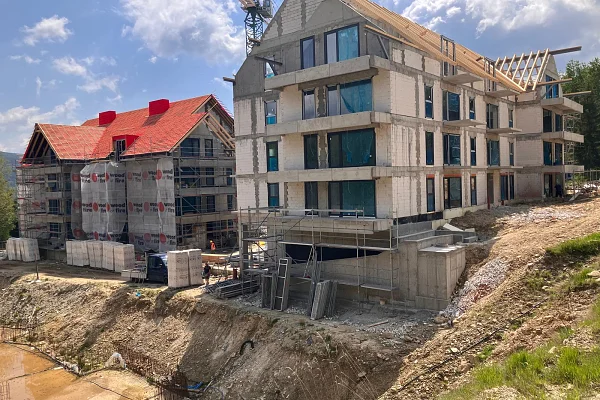
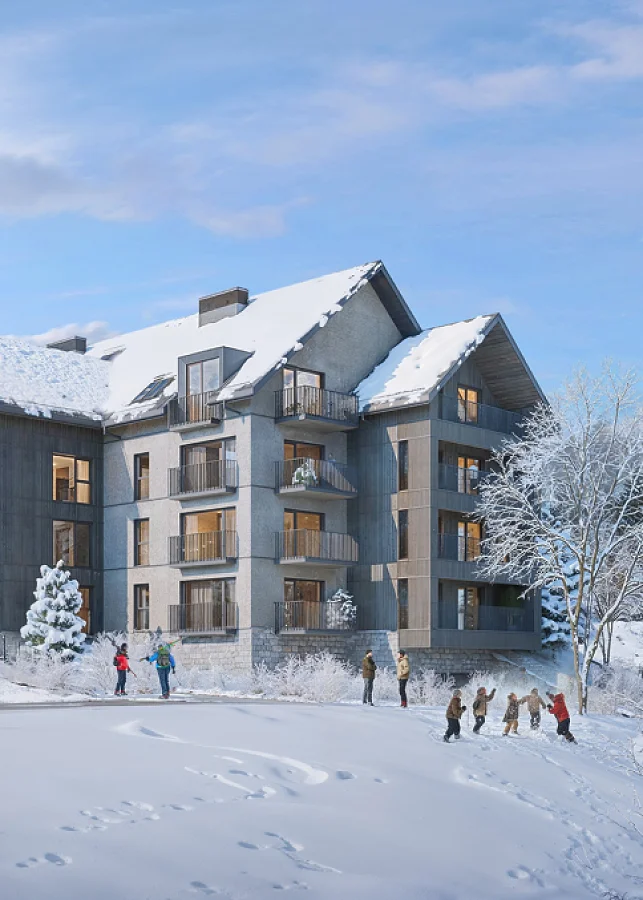
An example of a development in which accessibility for people with disabilities was taken into account at the design stage is Izera Park in Świeradów-Zdrój.
It is a project delivered with the idea of aging in place in mind – living in a single, well-designed environment for decades to come. This means:
- lifts in all buildings, enabling free, barrier-free movement,
- wide corridors and passages, also adapted to the needs of people with limited mobility,
- the absence of thresholds and a clear, logical layout of the shared areas,
- comfortable approaches to apartments, garages and shared zones, ensuring ease of use every day.
In addition, a reception with concierge supports residents with everyday matters, which has an enormous impact on the comfort of seniors and people with limited mobility.
Izera Park shows that an inclusive place to live can combine the architectural accessibility of the building with care for social relationships, the proximity of greenery and the quality of the space.
Video: https://www.youtube.com/embed/L5iWfZVt0dk
A responsible developer and long-term thinking
Building accessibility for people with disabilities should not be treated as the minimum required by the regulations. It is part of being responsible.
A responsible developer analyses not only construction costs but also the long-term impact of a project on its residents. Taking the needs of people with disabilities, seniors and neurodivergent people into account translates more fully into the durability of a community and quality of life.
Investing in apartments that are fully accessible and welcoming to every age group guarantees a broad range of buyers – from young families to affluent seniors seeking comfort. An investment in Izera Park apartments, thanks to the application of aging-in-place principles and high standards of inclusivity, is a product resilient to demographic change. If you are interested in investment apartments in the mountains that combine modern architecture with full functionality and long-term returns, find out more about our standards. Write to us!
If you would like to learn how the process of designing a development with accessibility and inclusivity in mind looks in practice, get in touch with the Proxin team or visit our sales office. We will be glad to show you how we translate good practices and building accessibility standards into real, comfortable spaces for living.
Get in touch with the Proxin team: sprzedaz@proxin.pl / +48 603 711 805 / izerapark.pl